
Easton City Directory Collections
The Henry F. Marx Local History Room at Easton Area Public Library is the verified starting shelf for historical Easton city directories. Its holdings begin in 1855. The library’s public material does not provide a complete online list of annual volumes, publishers, reverse runs, or a final print year, so a claimed gap or a claimed complete run would overstate the evidence. Confirm the exact year with Marx Room staff and inspect the title page of the volume used. The same collection also brings together yearbooks, family files, maps, local newspapers, and church and cemetery material, which makes it useful when one printed name needs context.
| Easton collection | Verified span or scope | Where held | How to use it |
|---|---|---|---|
| Published Easton directories | Beginning in 1855 | Marx Room, Easton Area Public Library | Confirm individual annual holdings and inspect in person. |
| 1890 Census Directory | 1890, Northampton County | Easton Area Public Library | Dedicated digitized PDF for a name-and-address example. |
| Local newspapers | Microfilm since 1799 | Marx Room | Use indexes, request forms, microfilm, and library databases. |
| Church and cemetery names | Twenty-eight church collections; more than 200 volumes | Marx Room | Search the church and cemetery records index after a surname hit. |
A directory listing is a contemporaneous compiled reference, not conclusive proof that every named relative lived at an address. Capture the printed year, spelling, page, street, and any mark before comparing it with a newspaper, deed, probate docket, or census record. Note: Annual directory gaps and publisher details should be confirmed from the exact Marx Room volume.
Easton Directory Research at Marx
The Marx Room provides a practical in-person route when a web search stops at a surname. Its local-history and genealogy collection has more than 15,000 items, including photographs, pamphlets, periodicals, maps, yearbooks, family files, published directories, and more than 200 church and cemetery volumes. Local newspapers are on microfilm from 1799. The room lists Internet computers and Wi-Fi, so a visitor can compare a directory entry with the library’s local indexes while preserving the precise spelling found on the page.
Its posted hours are Monday through Friday, 10 a.m. to noon and 1 to 4 p.m., and Saturday, 9 a.m. to noon and 1 to 5 p.m. The room is at 515 Church Street in Easton, and its phone number is 610-258-2917. Bring the surname, an approximate year, and any old street form. Staff can help identify a relevant volume or microfilm, but the research record supports checking availability rather than assuming a particular annual issue is on the shelf.
The Marx Local History Room is the source for the collection and access details shown below.
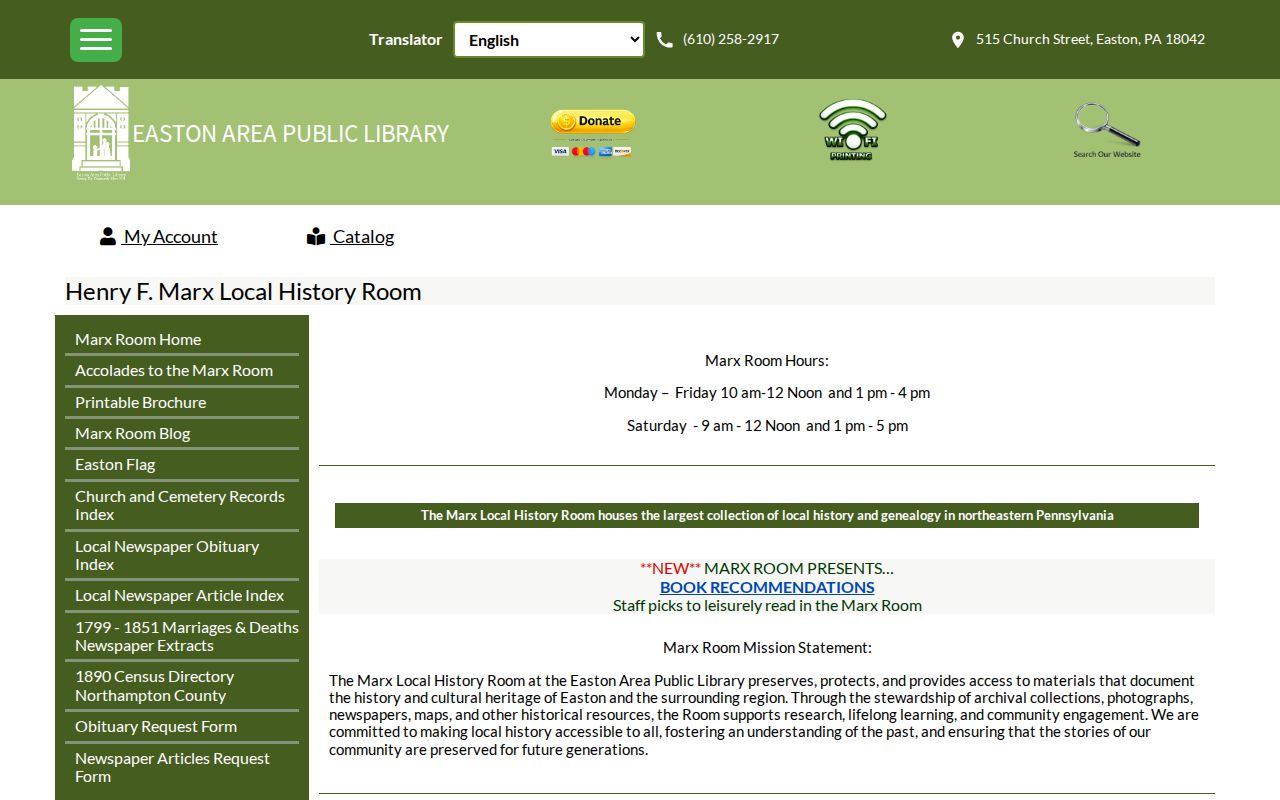
The Marx Room is the local channel for confirming exact city-directory years, checking a volume’s abbreviation key, and pairing a printed entry with related historical material.
Reading an Easton Directory Entry
The library’s digitized 1890 Census Directory of Northampton County offers an inspectable local example. Entries visibly pair a personal name with a numbered street address. Some also contain an occupation, business affiliation, or household-name string. One inspected address uses the prefix r.. The inspected portion does not provide a universal expansion for that abbreviation, so preserve it exactly unless the title page or key in the particular volume explains it. Do not turn an absent spouse, child, boarder, or neighbor into a confirmed resident merely because a family name appears nearby.
| Printed name | Transcribe surname, given name, initials, and nearby alternate spelling exactly as printed. |
|---|---|
| Street line | Record the numbered address and printed locality; historic labels can differ from current usage. |
| Occupation line | Keep any occupation or business wording as a clue, not as proof of a later connection. |
| Residence mark | Copy r. or another mark as printed until the exact volume’s key proves its meaning. |
| Page and year | Save both so another researcher can return to the same contemporaneous entry. |
Later city directories may have an alphabetical section, a street section, or both. Inspect the structure instead of assuming a reverse lookup exists for every year. A directory may help establish a time window, but it does not list every renter or household member.
Easton Directory Surname Clues
When a directory produces a name but not enough family detail, use the Marx Room’s separate obituary index, newspaper article index, 1799 to 1851 marriage-and-death extracts, and church and cemetery records. The church and cemetery index covers names appearing in records from twenty-eight churches. The room also reports a growing WPA-era master index of baptism, marriage, and burial names. These are surname-oriented sources, so they can test a date of death or family unit without treating a street entry as a complete household roster.
The Marx Room church and cemetery records index shows the kind of local collection that can follow a directory finding.
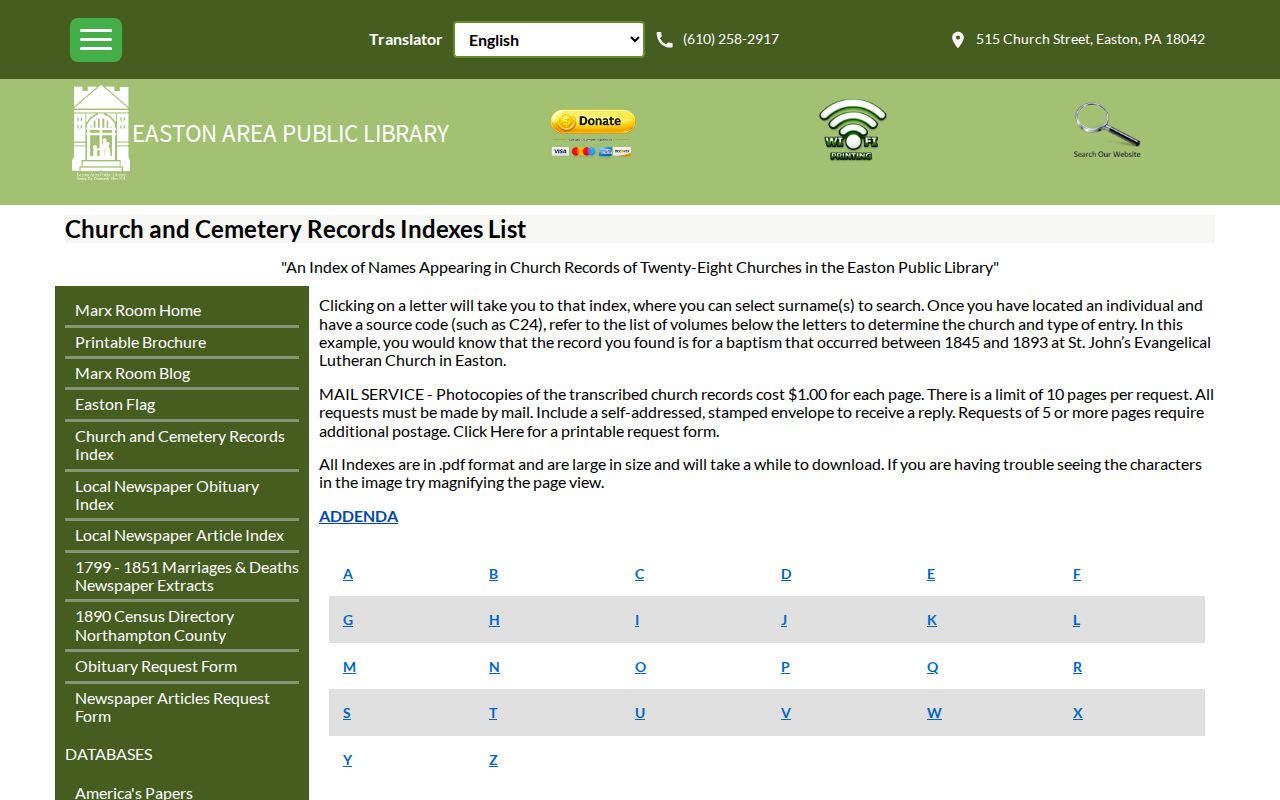
After noting a directory name and year, use a newspaper or church-and-cemetery index to establish a separate date or relationship lead, then ask the appropriate custodian about any underlying record.
Easton Directories and South Easton
Historic place language matters in Easton city-directory research. The Library of Congress catalog for the April 1904 Easton map identifies South Easton as a secondary place name. A newspaper, directory, or deed may therefore use South Easton where a modern searcher expects Easton. That is a search term to test, not proof that an old address is inside today’s city limits. The map describes buildings, materials, and use at its map date. It does not identify residents, so pair it with a name-bearing directory, deed, or newspaper.
- 1752: Northampton County was created, and the State Archives guide documents county deed material from that first county era.
- 1799: Marx Room local newspapers begin on microfilm.
- 1855: Verified Easton city-directory holdings begin at the Marx Room.
- 1904: The free Easton and South Easton Sanborn set provides thirty-seven map sheets.
This timeline separates the kinds of evidence available at each point. A map answers a building or label question; a directory supplies a printed name-and-address clue; county land records can take a title trail further back.
Easton Directory Terms
Reading historical books is easier when the book’s own arrangement is clear. Copy an unfamiliar mark before expanding it, and photograph or note the title page and abbreviation key when the collection allows. That precaution keeps a transcription tied to the exact printed source instead of an assumed modern meaning.
- Criss-cross directory
- A directory section arranged by street and address rather than by surname. The research confirms dated cross-reference directories in Marx holdings, but not a run for every year.
- Householder index
- A name-focused listing that may identify the household contact. It is not a complete count of every person at an address.
- Abbreviation key
- The publisher’s explanation of shortened marks and terms, usually found in the volume itself. Check it before expanding a symbol.
- Index versus source page
- An index points to a possible entry; the printed page supplies the wording that should be transcribed and compared.
For present-day address-keyed records, the Easton street directory follows a different path through parcels, maps, and recorded documents. Historical volumes work best as a time-bound household clue.
Tracing Easton Directory Households
Use city directories to narrow the years when a household appears, moves, or disappears. The federal census is released seventy-two years after its census date, so the most recent public decennial census in 2026 is 1950. A directory can supply the annual bridge between public census years, provided its limits remain clear. Preserve original spellings and old locality labels such as South Easton while testing the result in another independent record.
- Start with the known surname or address in a named directory year and capture the printed entry exactly.
- Check adjacent available volumes for a first or last appearance, without assuming every year is held.
- Use a street or cross-reference section only when the specific volume contains one.
- Compare the resulting interval with a public census, a deed or tax assessment, an obituary, or an allowed probate route.
- Record which source supplied each fact so a move, death, or spelling change is not inferred from one disappearance.
A person missing from one issue may have moved, died, been omitted, or been listed under a variant. The Marx Room’s obituary and newspaper tools can narrow the question. If a historical finding needs a separate modern record check, use the Easton resident lookup workflow rather than treating the old listing as current evidence.
Easton Directory Research Beyond Marx
When library directories end, the next route is repository-specific. Northampton County Archives refers researchers to the Marx Room, the Sigal Museum and Northampton County Historical and Genealogical Society, map partners, and the Pennsylvania State Archives. The State Archives guide documents Recorder deed books from 1752 through 1866 and other county groups, while county Archives materials include longer-running historical records. Those holdings extend a research trail, but the relevant book, roll, or file must still be confirmed with the repository.
The Archives gives older-name research a separate access path. In-person historical research has no research fee. A mail or email name search is $5, and copies cost 50 cents per page. Use that service when a question is sufficiently focused, while using the Marx Room first for its local directories, newspapers, and surname indexes.
The Sigal Museum and Northampton County Historical and Genealogical Society are among the local research partners identified in the county’s historical network.
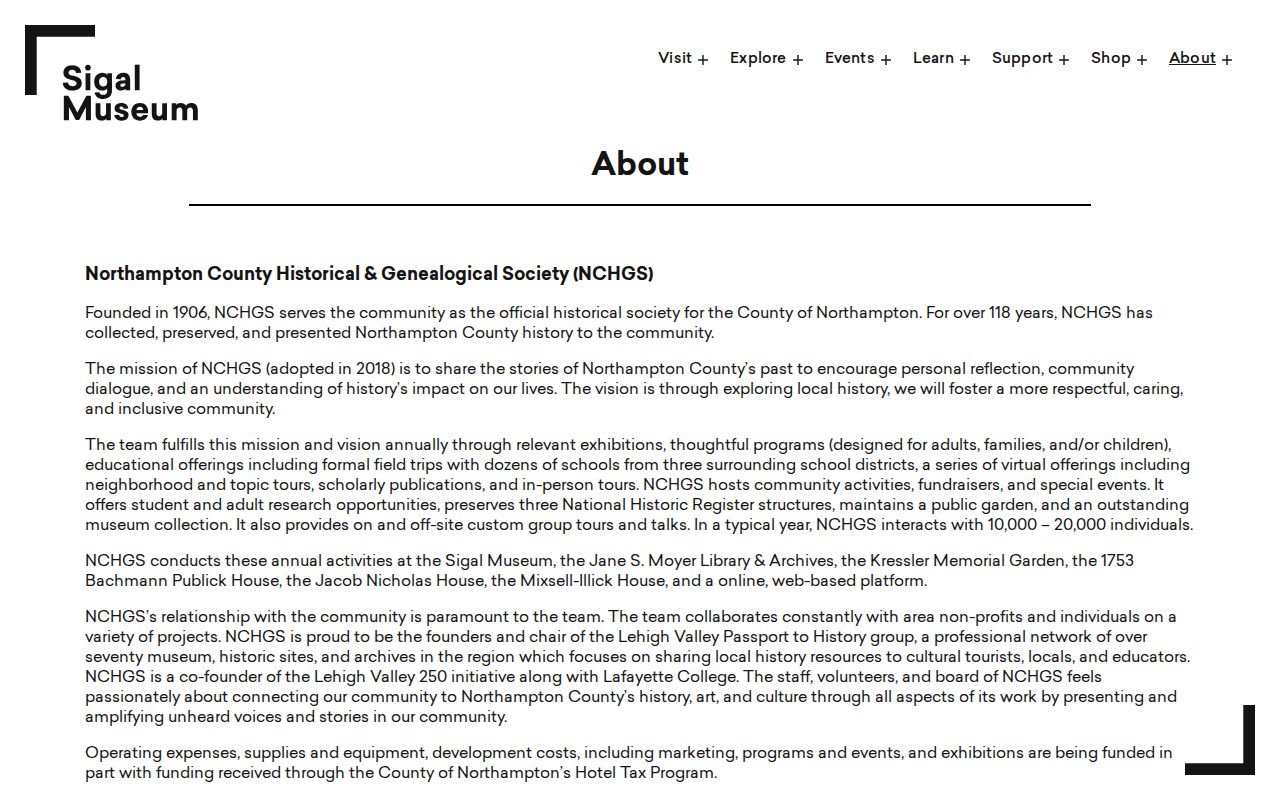
The useful sequence is directory and newspaper material first, then county land or probate records, archival guides, and church or cemetery collections when the question calls for each record type.
Note: Repository referrals identify research channels, not proof that every person or annual volume appears in a collection.